For years health experts have
sounded off about the nutritional pitfalls of eating too much bread. If we keep
up with dietary guidelines, that means our culinary life is probably short on
paninis, dinner rolls, garlic bread and pizza crust. One of the top problems
cited is bread has high carb in its content. Our body breaks down carbohydrates
into glucose, which is released into the bloodstream to give us energy. In an
ideal world, we burn all this fuel. But if we eat more carbs than we need, the
excess is converted to fat. Not surprisingly, high carb diets put us at
elevated risk for obesity, heart disease and Type 2 diabetes.
The rub with bread is that one
slice (of most kinds) averages 13 to 18 grams of carbohydrates. It might not
sound like much, but the recommended daily carb limit for a 1,500 calorie diet
is 150 grams. It is not hard to see how overeating in bread can help push us
over the mark.
Another drawback is that bread
grains also contain antinutrients, plant compounds that prevent our body from
absorbing certain minerals like magnesium, calcium and iron.
If life without bread feels a
little less radiant, there is no need to keep saying no. Not all bread is
created equal when it comes to health. Some types are far better for us than
others and can be part of a healthy diet.
One point in favor to eat bread all
breads are high in carbs, but not all carbs have the same effect on the body.
Whole grain bread is made from flour that contains the entire grain (bran, germ
and endosperm). We can recommend too that looking for breads made from sprouted
grains. This option helps we avoid most of the nutritional drawbacks of other
breads. One of the most popular sprouted grain breads is Ezekiel bread,
made via an ancient method that involves soaking organic whole grains (like
wheat, lentils, soy and barley) in water and allowing them to sprout before
baking. No flour is used. The sprouting process confers numerous health
benefits. These breads not only contain more fiber, protein, vitamins and
minerals than other breads.
Enjoy, but do not overdo it. If we
love bread, there is no need to give it up altogether. Just look for the
healthiest options and eat it in moderation. In addition to bread which has high
carb in its content, they are relatively rich in calories. Even so, with a
little discipline and smart shopping there is no reason we cannot have our
bread and eat it too.
What is the difference between
artisan bread and regular bread? Artisan bread uses traditional methods, only
uses natural ingredients, takes longer to make, cannot be made on a large
scale, or is made by an artisan.
Artisan Bread Uses Traditional
Methods: We can find many comments that artisan bread is better than regular
bread because it is made using traditional methods. Some said that artisan
bread should only contain four ingredients. It should only have flour, water,
salt, and yeast and even then, they said that yeast might be left out. We found
enough of other information that said that traditional methods meant that it
had to be an authentic recipe. In addition, artisan bread is different from
regular bread because it has an irregular shape and there is no cookie cutter
process to making artisan bread.
There are artisans making bread
that say the bread is not artisan bread if it is made on a large scale or it is
not handmade. Kneading the dough is obviously an important part of making any
bread and there are many claims by small artisan bakeries that say the dough must
be kneaded by hand to be considered artisan.
However, we were able to find other artisan bakeries that say, that it does not matter if it is a hand or with a machine process because there are very few artisan bakers who have not embraced the time and energy. We all know of plenty of artisan breads that are made on a large scale and are not handmade. No one can or will put a number on it and no one can define what limited quantity or large scale is. This claim to separate artisan bread from regular bread seems to be the weakest differentiation of all the claims that we found.
Artisan Bread Only Uses Natural
Ingredients: Some claim that artisan bread is made with only four ingredients
of flour, salt, water, and yeast. Some bakeries say that the type of flour that
is used is what makes a bread artisan verses flour that is used in all other
bread.
The most common claim under the
heading of natural ingredients separating artisan bread from regular bread is
that artisan bread does not use chemicals. We can see, all bread has a chemical
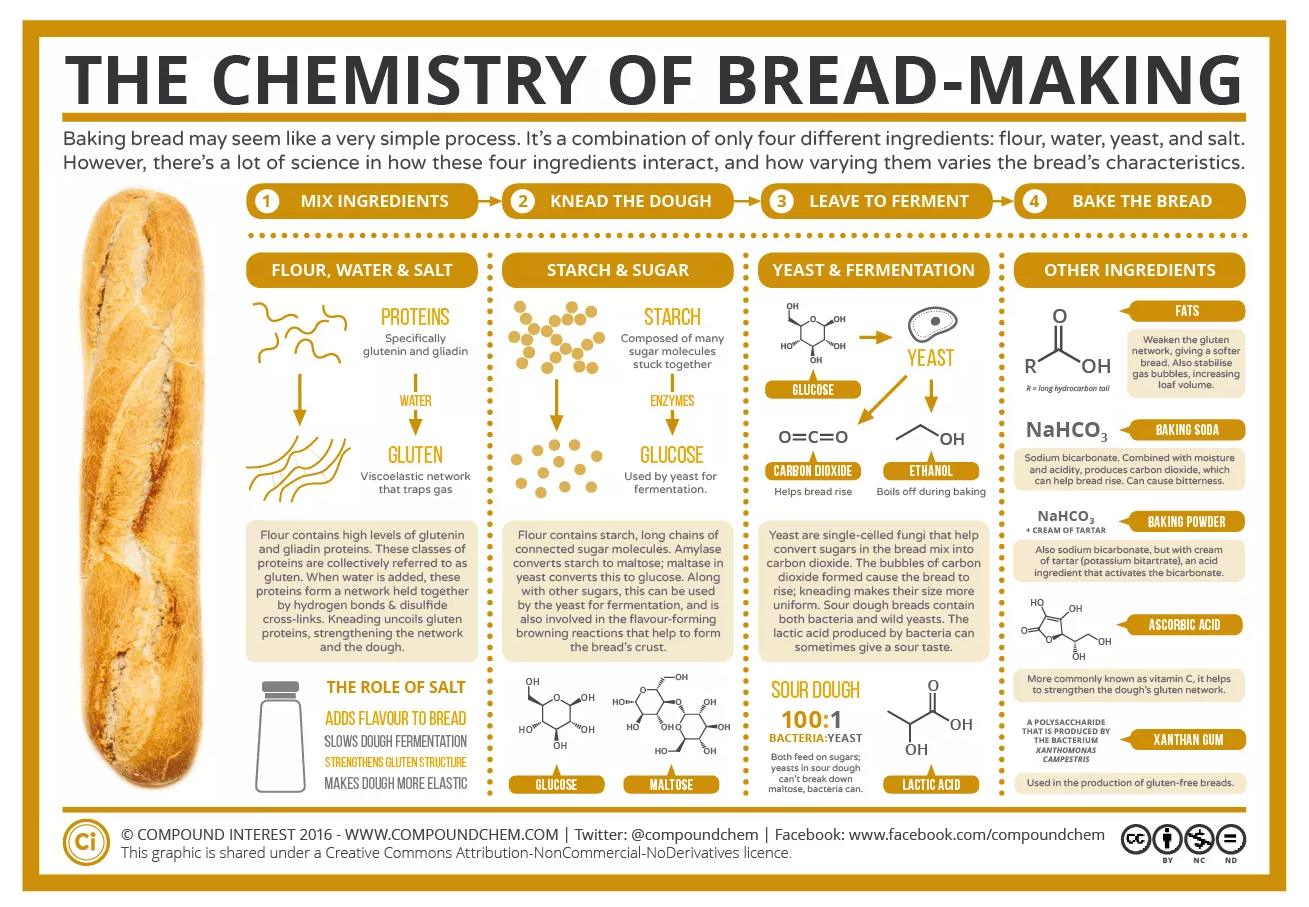
reaction. The leavening or rising of the dough is the yeast letting off a
carbon dioxide gas that is trapped in the dough. The flour has gluten in it
that essentially feeds the yeast and helps create the gas. Fermentation is
really a chemical process.
So, what is the difference between
artisan bread and regular bread? We
believe that artisanal is sometimes used in marketing and advertising as a catchword
to describe or imply some relation with the crafting of handmade food products.
This is a perfect example of a bakery with a high potential of production. Here is the history of this great bakery.
In 1991, the Perfection Biscuit Company developed a flagship brand to represent our passion for baking. We developed a spokeswoman to represent this new line of authentic, “home-style” breads – Aunt Millie. Customers readily identified her as caring, loving, and always baking something wonderful. Aunt Millie became so popular that in 2005, the company was renamed “Aunt Millie’s Bakeries”.
Today, Aunt Millie is still committed to baking the healthiest, highest quality bread possible. Many of Aunt Millie’s breads are whole grain, and ingredients are held to the strictest standards. From one generation to the next, folks are being raised on Aunt Millie’s baked goods. At Aunt Millie’s, we bake more than bread – we bake memories.
Aunt Millie’s Bakeries is a family-owned company headquartered in Fort Wayne, Indiana. It operates six bakeries in three states, producing bread and other bakery products. Aunt Millie’s many brands are distributed throughout the United States, with primary distribution in the Midwest.
The company was founded in Fort Wayne in 1901, by John B. Franke, as the Wayne Biscuit Company. President John F. Popp is the grandson of the founder.
Aunt Millie’s Bakeries employs about 1,600 people in Indiana, Michigan, Illinois, Ohio, and Kentucky, and operates two bakeries in Coldwater, Michigan, and bakeries in Fort Wayne, Indiana; Jackson, Kalamazoo and Plymouth, Michigan; and Sidney, Ohio.
Aunt Millie’s produces baked goods including bread, buns, rolls.1901
John B. Franke founded the Wayne Biscuit Company in Fort Wayne, Indiana. Using the finest ingredients possible, the company produced Perfection Wafers (P.W. Crackers), and later breads, cakes, and cookies. Special attention was given to customer service. The goal of the new company was “perfection,” and the company was later renamed Perfection Biscuit Company.
1923
The Perfection Biscuit Company was the first bakery in Indiana to offer wrapped bread to its customers.1927-1940s
Many changes occurred in the company. J.B. Franke was killed in an auto crash in 1927, and the business’ reins were soon passed to his son-in-law H. Leslie Popp, Sr. This fair and straightforward man was instrumental in introducing sliced bread to the area. He also expanded the bakery to include interstate business and new product development.1950s
As the bakery passed its 50th anniversary, product lines were changed to meet consumer needs. The cracker and cookie lines were phased out, while emphasis was placed on developing quality breads.
In 1954, Perfection began distributing Sunbeam Bread, and in 1957 erected a mechanical Sunbeam sign on the roof of its Fort Wayne plant. This distinctive sign is a Fort Wayne landmark to this day.1960s
Perfection broadened its scope by purchasing the Muncie Bread Company in 1961, and Schafer Bakeries in 1964. In 1965, Perfection acquired the Gase Baking Company, which was one of the first bakeries in the industry to install a pneumatic flour unloading system.1970s-1980s
Leadership of the company passed to H. Leslie Popp, Jr., grandson of the founder, who in 1978 supervised the construction of the existing company headquarters in Fort Wayne. In 1980, another grandson of J.B. Franke, John F. Popp, was named president of Perfection, and soon afterward acquired the Way Baking Company. Perfection continued to expand into the southwest Ohio and southern Indiana markets.1990s
A new bakery was built in Coldwater, Michigan, where Perfection moved its bun production in 1990. Also in 1990, the company was renamed Perfection Bakeries, Inc. The Aunt Millie’s fine line of breads began to flourish in 1991. The distinctive silhouette of Aunt Millie’s soon became synonymous with delicious, old-fashioned quality bread products. Realizing the national trend toward healthy eating habits, Perfection became a pioneer in the industry by introducing Aunt Millie’s Fat Free Breads.
To better accommodate the growing company, Perfection opened a bakery in Sidney, Ohio in early 1996. The Sidney facility has become Perfection’s most efficient bun bakery. Also in 1997, a secondary bakery opened in Coldwater, Michigan.Today
Today, Aunt Millie’s operates six bakeries and distributes its many brands throughout most of Indiana, Michigan, and Ohio. Aunt Millie’s is continuing to expand into eastern Illinois and northern Kentucky. Aunt Millie’s celebrated its 100th anniversary in 2001. Today, special attention is given to customer service, and our goal remains “perfection.” In 2005 the company opened a sixth bakery in Plymouth, Michigan, and the company name was changed from Perfection Bakeries to Aunt Millie’s Bakeries.
The best video budget is your HD video camera on your cell phone. Using this tool, you can shoot your videos. Your customers can see the integrity of your artisan bread during the process of making. But the most important, you are going to give your customers the opportunity to see some customer behavior of your post in any social media platform. We recommend the most popular such as Facebook, Instagram, Pinterest and LinkedIn. At the end, it is your preferences on social media platforms.
Tip #2: Upload Photos Every Day
Bakeries put out fresh artisan breads every day; we recommend following the same rule of videos with your pictures on Facebook or any social platform. In this case, it is important, the instant and the image that you want to give, consequently, the quality of the photos will reflect the quality of the artisan bread to the online customer or community, so make sure the photos are with the highest quality. Posting photos regularly, you are given to your customers the message that there is a special promotion of artisan bread, never forget to pat attention in what you are posting to give a sequence of your post. Bakeries think that posting a photo of the best artisan bread of the day is an effective behavior that will increase sales. But never forget to show variety in artisan bread that your bakery is manufacturing as well.
Tip #3: Create a Memorable Profile Image
It vital for your marketing promotion to have a profile image for your business. It must be remarkable and original. The idea is to keep in your customers’ mind that your bakery is the best option for artisan bread. You need to select a photo for your profile in any social media platform. You photo can be you in the main entrance of the bakery. For others, a photo of the best of artisan bread. And some profiles used a logo that it is used with your marketing campaigns. Whatever image profile, you prefer, it must memorable in the mind of your customers.
Tip #4: Network with Your Competition
The competition is the cornerstone for a healthy contest among other bakeries. Using meet people shoulder to shoulder with owners of competing bakeries keeps the creative and the innovation of your business. It is also an opportunity to discover what is working and has worked well for others. It is a health way to make benchmarking in your business with the idea to improve the quality and image of your artisan bread.
It is important to know the different perspectives about how to bake an artisan bread. One important aspect is to recognize between a fermented bread and a yeasted bread.
Baking bread is a process where many reaction happen when we are baking an artisan bread. At the process, making bread involves mixing together flour, water, commercial yeast, and salt, letting the mixture rise, and baking the risen dough. During the rising period, the yeast gobbles up some carbohydrates in the flour and digest them via fermentation. The end products are alcohol and carbon dioxide. Consequently, the reaction adds flavor and volume to the dough. Now the question is a fermented bread is better that a yeasted bread.
The fermented bread does not spike blood sugar, and has more magnesium, zinc, iron and B12 in it. How it works is simple. The potential fix is opting for long fermented breads, or true sourdough breads, made via traditional bread baking methods, meaning they are fermented with a sourdough starter for at least 12 to 15 hours. A long fermentation breaks down gluten proteins into smaller fragments, and for some, this improves digestibility.
So
should everyone switch to fermented bread? Long fermented breads also have a
lower glycemic index, it can help for those with diabetes. I believe that baking
with natural leaven is in synchronization with the nature and maintains the
integrity and the nutrition of the cereal grains used in the process. This
helps to increase and reinforce the absorption in our body of the nutrients in
the cereals.
In contrast,
the yeasted bread has numerous practical advantages. The fermentation is more regular,
more rapid, and the bread rises better. But the fermentation becomes mainly an
alcoholic fermentation and the acidification is greatly lessened. The bread is
less digestible, less tasty and spoils more easily.
At the end, we should understand that It is important to recognize the basic differences between the fermented bread (sourdough) and the commercial yeast in most other breads. First sourdough yeast grows best in acidic dough, while the yeast does better in neutral alkaline dough yeast is a single type, with hundreds of strains and varieties, while sourdoughs are usually leavened by one or more types in the same dough, none of which is yeast. Yeasted bread from bakeries is a highly uniform product that produces an equally uniform texture in bread dough. But the most notable difference between the two methods of growth are that a single package of instant dried yeast produces just one batch of bread, while the same amount of wild sourdough in fermented bread produces as many loaves as we need it.
It is awesome to know that
bakeries and experts no only talk about recipes. There is also a new tool
online where we can consult any word like a dictionary for knowing everything
about artisan bread and more.
One special topic about the artisan
bread is gluten free. Today, there is a lot of people who has a special condition,
and they cannot eat gluten. This condition is presented by people diagnosed
with gluten intolerance, gluten allergy or celiac disease. On the other hand, the
gluten is an essential part of the process of the artisan bread. Some aspects
of this condition is that they need to be sure that the bread is free of the gluten.
The standard process of baking bread makes impossible not to have a possible
contamination because the environment is full of the flour with gluten.
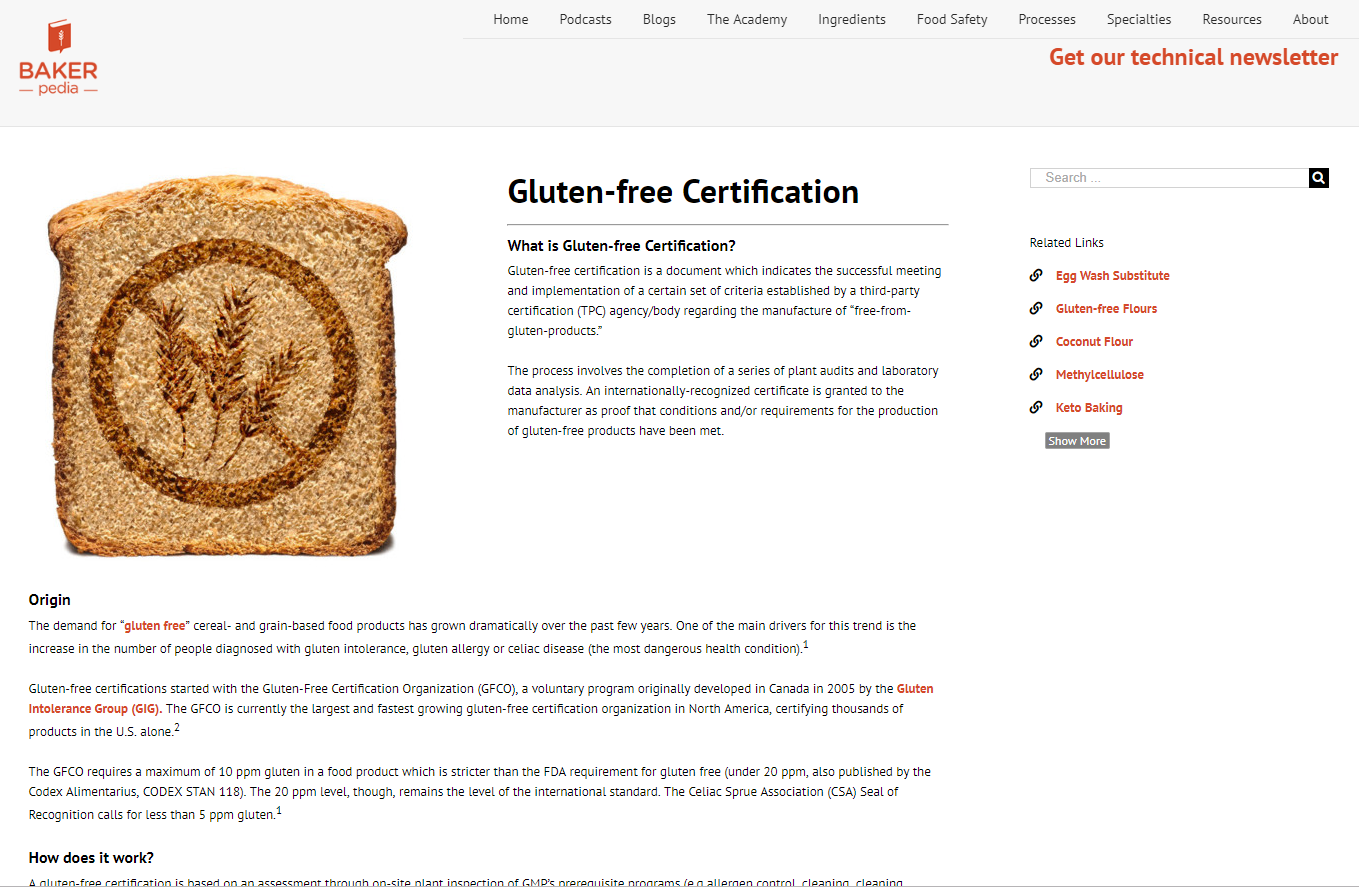
The content of this blog has
complete information because we can find data such as what is gluten free bread?
origin of this market, definition of this requirement by bakers, but the most
important, there is a difference between gluten free and very low gluten free.
Bakeries are looking for the predilection
of the market and keeping the position among the competition. Consequently, they
need to look for an expansion in other possible but potential buyers of artisan
bread. This is the reason why bakeries looking for gluten free certificate
bodies. There is not a lot organization that give a certificate to a bakery.
Here in this blog we can find some of them.
This blog is not only about to be
certificated, if not also, it gives us the enough information of how a bread is
baking and the whole process must be sure that the ingredients and primary
technics are the right to use by the bakers for manufacturing an artisan bread.
The blog is called bakerpedia. It is window to see the baking world from
multiples point of views.
It is important to say that in this
blog is introducing the experience of Dr. Lin. She is a professional baker and has
developed several tools for transmitting her knowledge that she has
experimented through years; she uses the advisement and the practice of an artisan
bread and more to show us another scenario of a recipe of an artisan bread
The blog menu gives us a tour
through the ingredients, the process, some podcast, an academy, several specialties
of breads, and the most important each section is supported by resources of high
prestige organizations such as U.S. Food and Drug Administration, International
Journal of Engineering, and Technology and Journal of Food Processing and
Preservation.
The relevant with this new multimedia
resource is that it opens our perspective of how an artisan bread must be baked,
and what condition are necessary for being sure that we are eating healthy.
Artisan Bread or Wonder Bread? – When we talk about bread, we have in mind a slice of wonder bread. Today people is looking for new flavors to share with the family. Artisan bread is baking that small companies make with traditional tools and technics to bake bread; the flavor is especial because they use local ingredients. Artisan bread should have a variety of hues in its crust, ranging from golden brown to a light golden color. In the other side the big companies use ingredients that they move from others states or countries and the flavor is different according to the area. You, what you prefer an artisan bread or wonder bread?
Do you prefer a sliced bread or cutting your own bread for yourself? – Some restaurant gives us, sliced bread but in some cases the restaurant takes the loaf of bread with a knife and rustic bread board in our table. Some people prefer the slices, but others love to do it by themselves. Probably the reason is because you can see the freshness in your loaf of bread and cut a slice of bread as you prefer is a great gourmet experience. What is your preference in the table?
100% natural (all ingredients from natural sources): Today is normal to buy bread to make a sandwich or for eating with our family , but people prefer a bread that it is able to be a good finish or glaze, especially on sweet breads, should be an indicator of quality. For a 100% natural artisan bread has a good finish is not something important. What kind of bread do you prefer? One with good finish and sweet taste or a bread where not every bread should look wet on the inside because a super wet and shiny bread is a sign of being hydrated and gelatinized, but usually people thinks that it is under-baked.
White bread or 100% whole Wheat: Whole wheat is processed to include all three nutritious parts, but white flour uses only one nutritious part. If you prefer the flavor and texture of white bread, it is great but if you want 100% natural nutritional benefits of whole wheat, choose whole wheat artisan bread. It is 100% whole wheat bread better! What do you think?
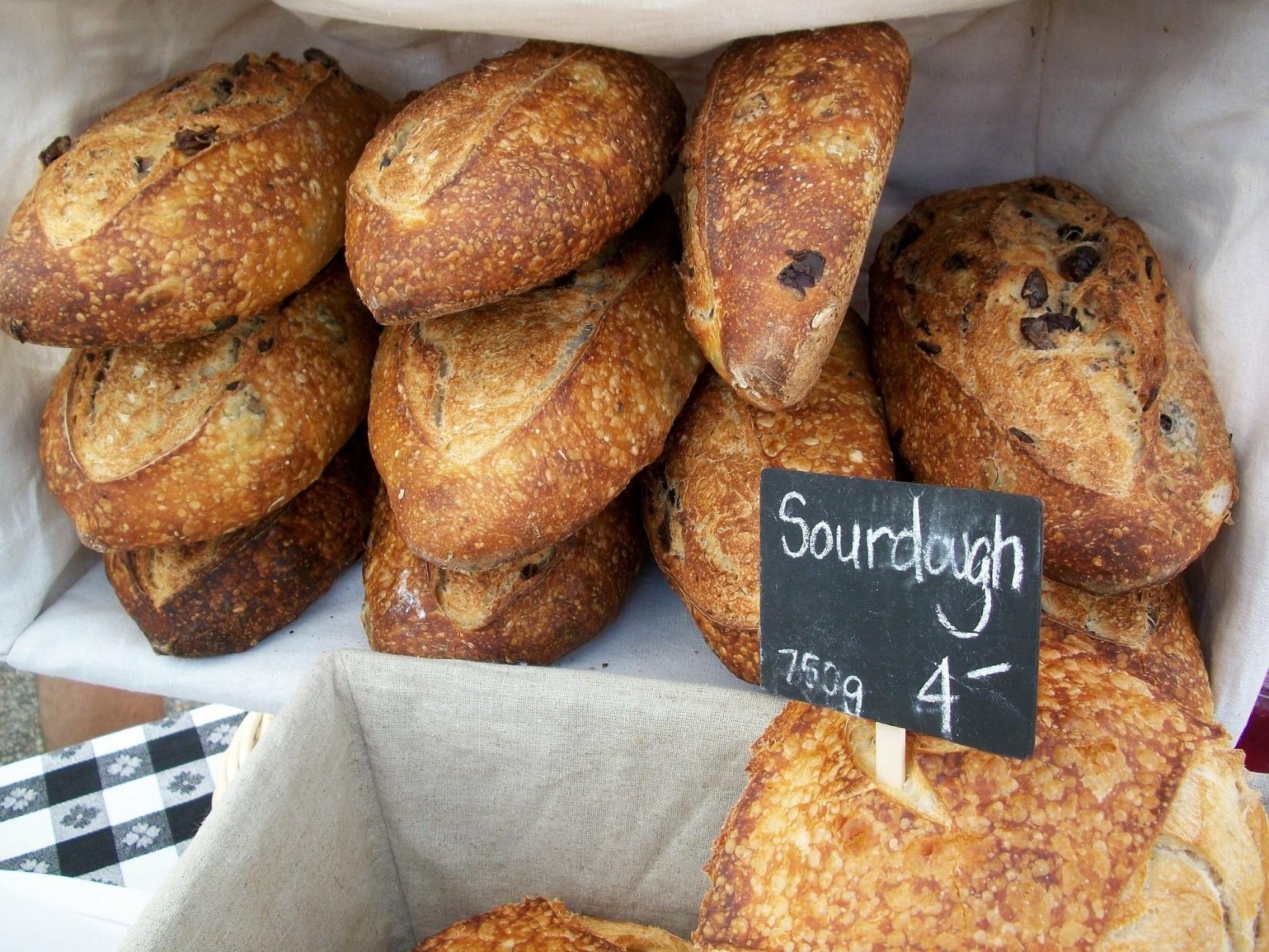
Sourdough bread is one of the healthiest breads – A bread whose dough rises during when the bread is making, it is the result of gas being produced. Most leavened breads use commercial yeast to help the dough rise. However, sourdough bread fermentation relies on lactic acid bacteria that is naturally present in flour to leaven the bread. Sourdough bread is frequently made with no sweeteners or oils. It contains whole wheat flour and water, and its secret ingredient. Buying sourdough bread from an artisan baker is a better idea with a 100% likelihood of being a healthiest bread. Are you willing to eat sourdough bread than a wonder bread? What you really like to taste in your table with your family?




 LaBread Bakery